Up front: we make MagicNexus. This is not an independent review and we are not going to pretend otherwise. What it is: a feature-by-feature walkthrough in the shape of a proper review, so you can see exactly what’s inside before installing it. If you want an outside opinion, the Google Play and App Store reviews are right there and we don’t touch them.
With that out of the way.
The spec sheet
| What it is | Companion app for Magic: The Gathering |
| Platforms | Android and iOS |
| Price | Free, all of it. Premium is in testing |
| In the stores | 5.0 on Google Play (7 ratings) and 5.0 on the App Store (1) |
| Languages | Spanish, English and Portuguese |
| Formats | Standard and Commander, with separate rankings |
| Try it | In a browser, nothing to install |
The way in: the life counter
Nobody installs a Magic app because of a worldwide ranking. They install it because they’re sick of tracking life on a phone calculator, with dice, or on a scrap of paper that goes missing halfway through the game. So the counter is the front door, and it had to be right first.
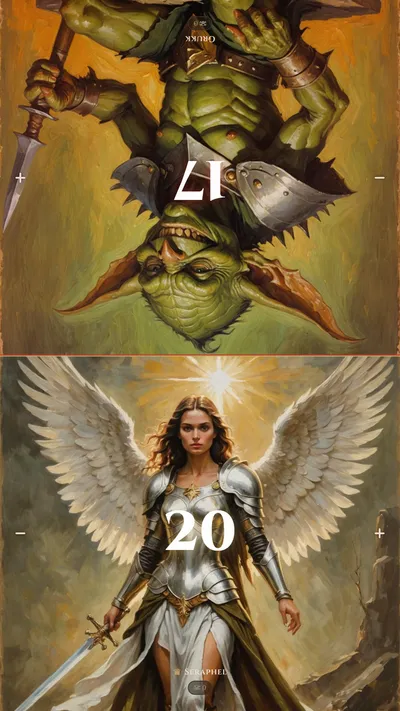
Up to four players, each with their own background, in Standard and Commander. The counters that actually matter are there: poison, commander, and commander damage — the one you have to track player against player, which on paper is an impossible grid.
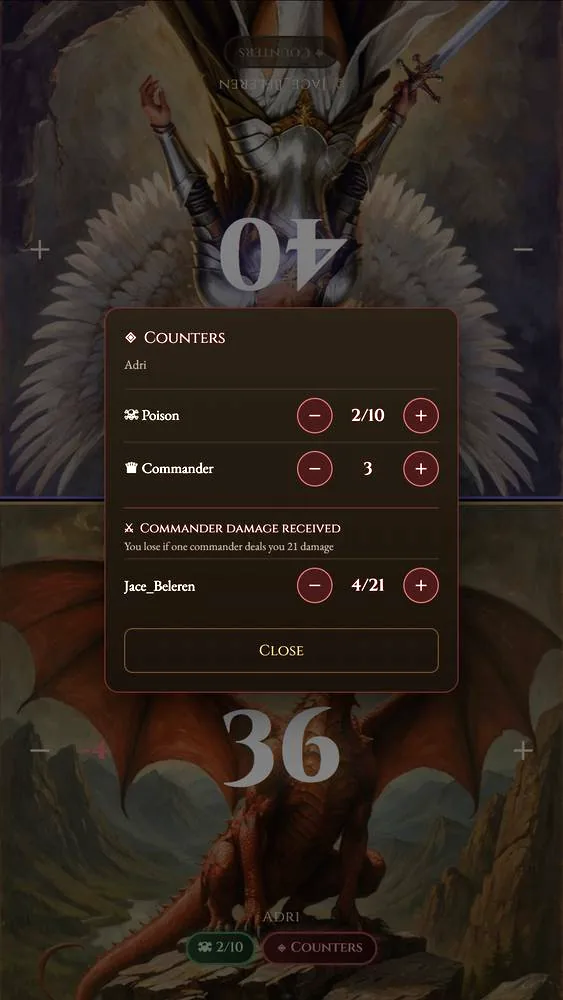
And there’s one detail that matters more than it looks: casual mode. A game marked casual doesn’t touch your ranking. That sounds like nothing until you’re testing a half-built deck against a friend and you don’t want those four losses tanking your standing. The serious history stays for the games you want to count, and everything else gets played relaxed.
The decks, and the creature that levels up
You save a deck by looking cards up through Scryfall’s search — the real database, every card and its art — put your commander’s art on the cover, and pick a background. So far, what you’d expect.
What you wouldn’t expect is that every deck gets a companion that levels up when you win. A creature that evolves with that specific deck’s victories: your deck isn’t a saved list, it’s something with a track record you can see. And it happens to solve the classic problem of any logging app, which is that people start entering the game and abandon it half-done. Here, finishing pays.
Every game counts
You finish, you note who played, with which deck, and who won. The app works out the scores and stores it.
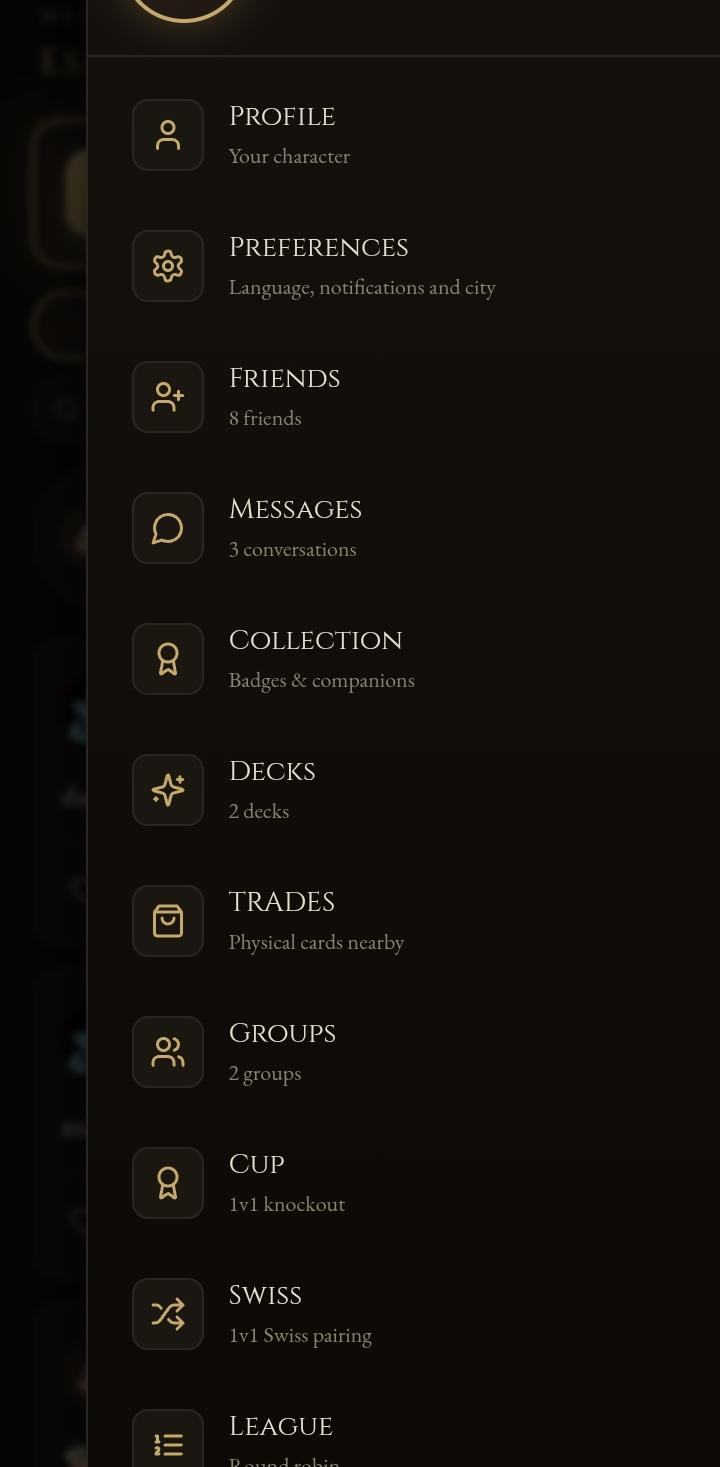
Everything else comes out of that: your full history, which of your decks actually wins and which only wins in your head, and the worldwide ranking by format — Standard and Commander keep separate tables, as they should. The ranking is also public on the web, with nothing to install: you can see who’s on top right now before you commit.
Groups and tournaments
The private group is the natural unit: your playgroup, its games, its internal standings.
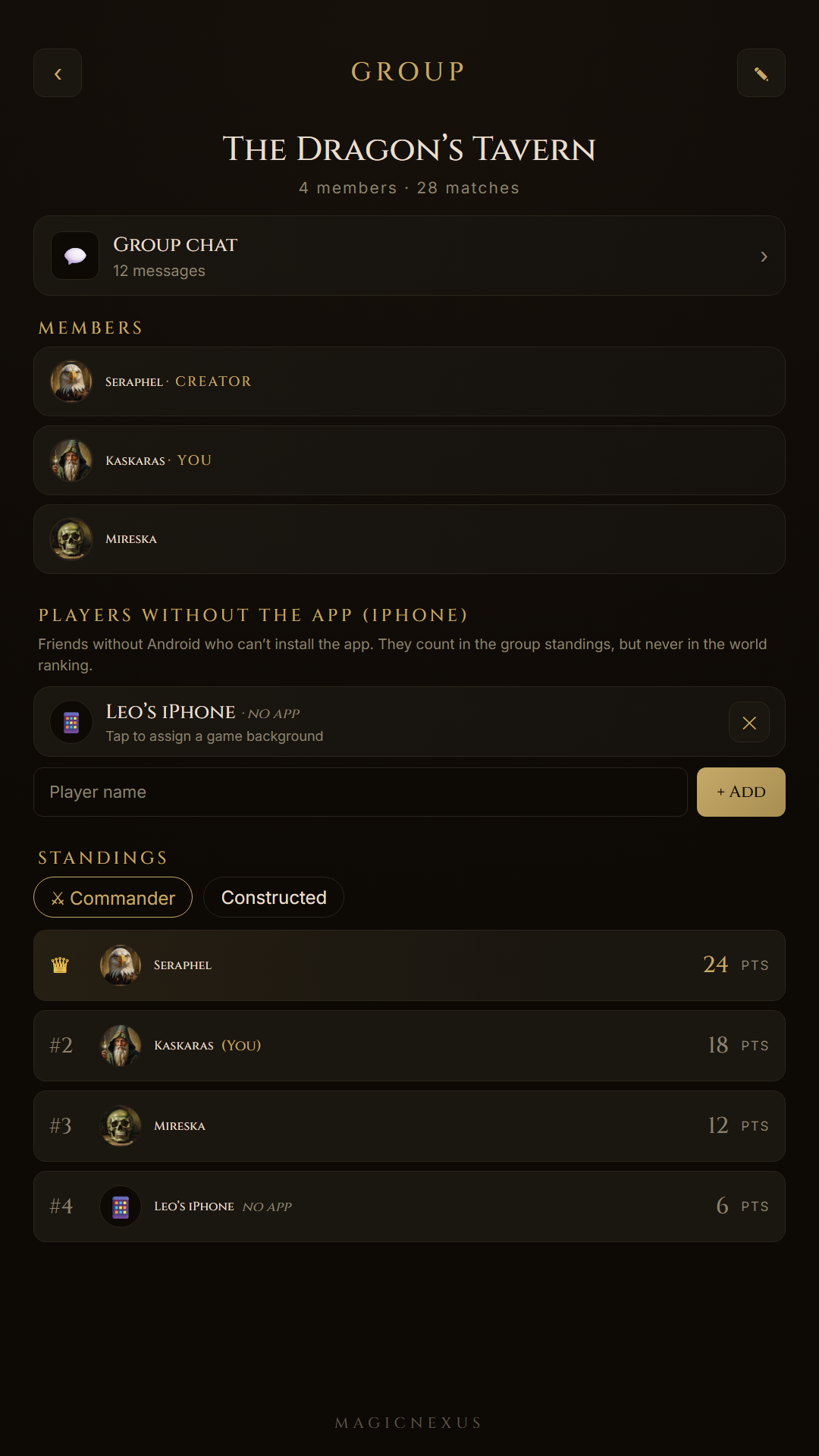
On top of the group you can run three kinds of tournament: Cup (single elimination), League (round robin) and Swiss with Top Cut, the format real tournaments use — Swiss rounds, then a cut to a bracket. The app handles pairings, results and standings.
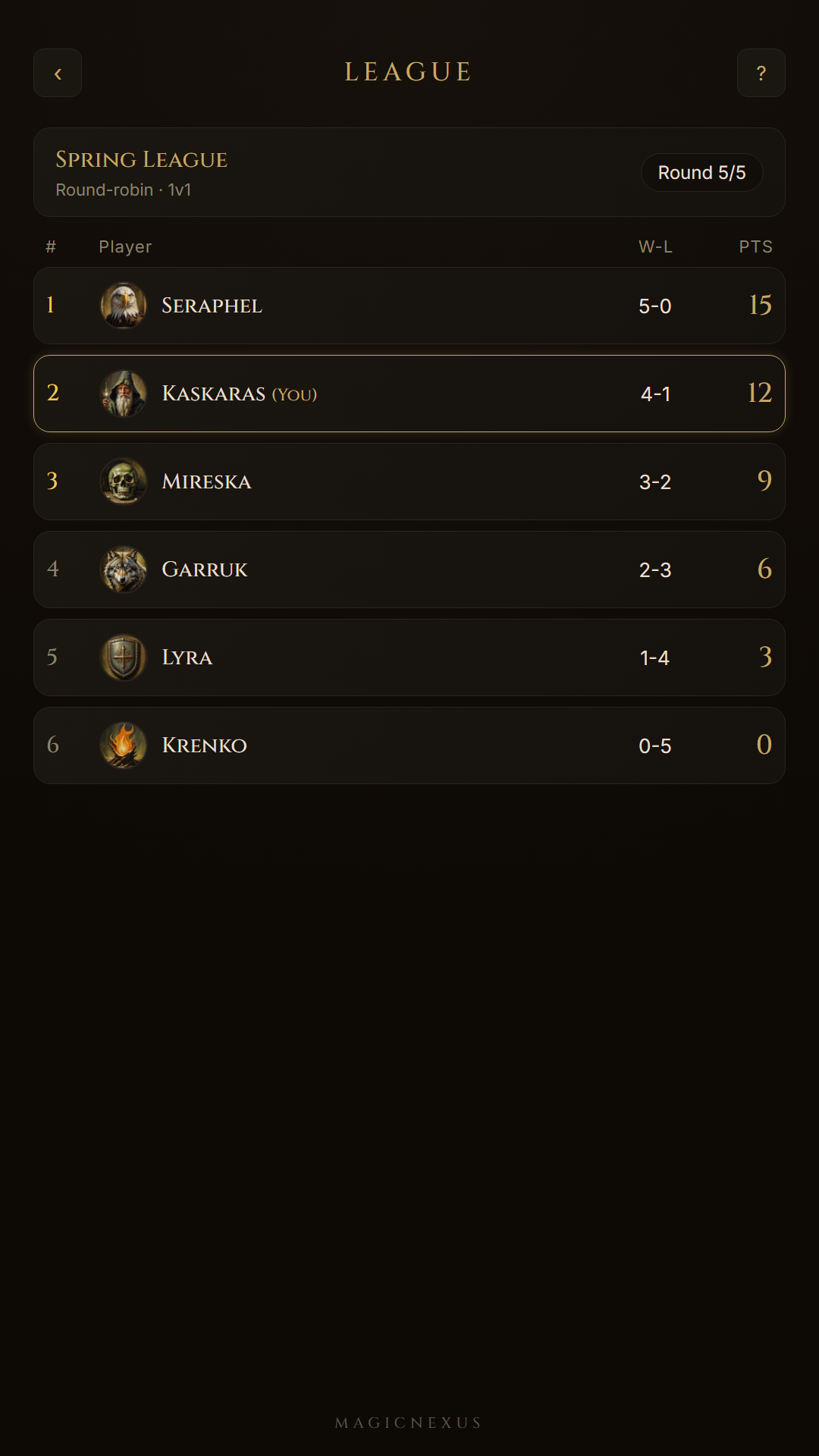
That Swiss-with-a-cut is in there tells you who this part is for: not just the Sunday game, but the group that organises something properly and has been running it on a shared spreadsheet nobody updates.
The trades board
Physical cards: what you’re selling, what you’ll trade, what you’re hunting. With GPS search to find cards and people nearby — the difference between trading a card and paying postage that costs more than the card.
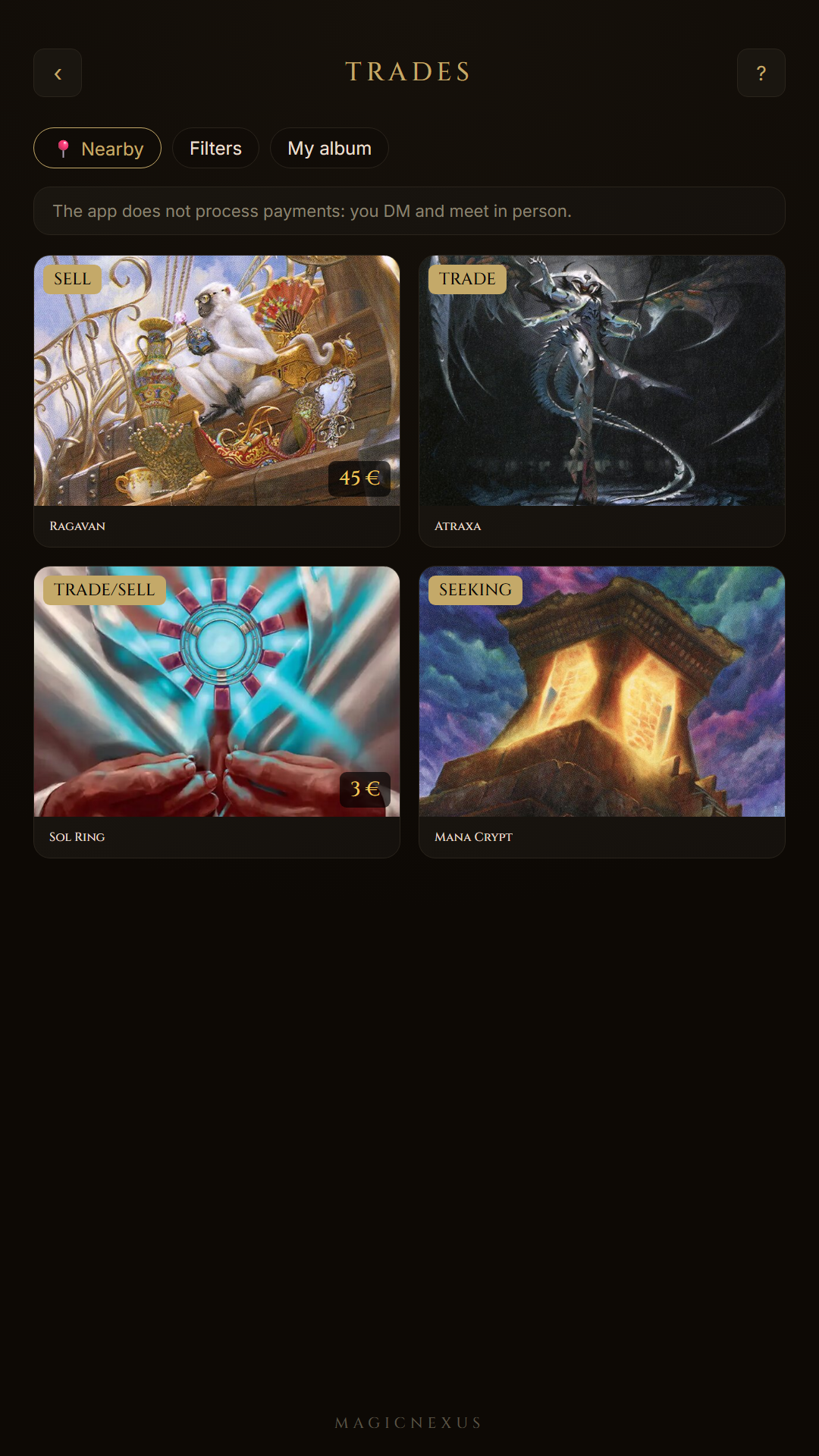
It’s also the natural way your group grows: the people near you who play the same game show up here before they show up anywhere else.
The feed
Game moments, comments, @ mentions, direct and group messages. It’s the social layer, and it sits where it should: behind the counter, not in front of it.
Group chat is the part with the most concrete use — arranging a game, closing a trade — and it saves the classic lost thread where nobody knows whether it’s happening on Thursday.
How it’s paid for
Free, and right now all of it: the Premium subscription is still in testing and can’t be subscribed to yet. Today there is nothing whatsoever to buy inside MagicNexus.
When testing ends, Premium will remove the ads and double the experience your deck companions earn. What it won’t do is unlock features: the counter, decks, history, groups, tournaments, ranking and trades will stay complete without paying. You will pay to remove advertising and to move faster through the cosmetic layer, not to be allowed to use the app. Nothing that matters is going to sit behind a paywall, and that’s a design decision, not a limited-time offer.
What the store says
We’re not putting a score on this ourselves. These are the reviews exactly as they sit on Google Play, where MagicNexus averages 5.0 from 7 ratings (and 5.0 from a single rating on the App Store). They are in Spanish; the translation is ours:
“La caña está App al fin una aplicación decente en el mundillo de Magic, muy muy contento! recomendable 100%.”
— Hugo MG, 29 June 2026 · “Great app, finally a decent one in the Magic world, very very happy! 100% recommended.”
“genial aplicación! Por fin puedo retarme con mis amigos de verdad”
— Catarina Castro, 16 July 2026 · “Brilliant app! At last I can properly challenge my friends.”
“Está muy bien para registrar tus mazos, jugar con amigos y ver luego el ranking”
— Héctor Moreno, 14 August 2026 · “Really good for logging your decks, playing with friends and checking the ranking afterwards.”
That’s seven ratings, not seven thousand: take it for what it is, a young app whose users are happy with it. The full, current reviews are on Google Play.
The good
- The counter covers what people track by hand: poison, commander, and commander damage between players.
- Casual mode, which separates test games from the ones that count.
- Real tournaments: Swiss with Top Cut, not just a bracket.
- Nothing sits behind a paywall: today the whole app is free.
- Scryfall search for decks, with real cards and real art.
- Separate rankings per format, which is how the game is actually played.
- You can try it in a browser, no install and no sign-up.
Who is it for?
You, if you always play with the same group and the competition bug has bitten: the internal ranking, the history and the tournaments are exactly that, and it’s where the app separates from any other life counter.
You, if you organise something — a store league, a tournament between friends — and you’ve been doing it by hand.
You, if you want to finally know which of your decks actually wins, from counted games rather than memory.
You, if you deal in physical cards and would rather trade with people in your area than pay postage.
MagicNexus is on Google Play and the App Store, free. You can see the ranking and the screenshots on the MagicNexus page, or try it in your browser with nothing to install.
And if you think of something the app should do and doesn’t yet, get in touch. A good part of what’s inside came from exactly that.
Frequently asked questions
- Is MagicNexus free?
- Yes, and completely so right now: the Premium subscription is still in testing, so today there is nothing to buy inside the app. MagicNexus is a free download on Google Play and the App Store, and every feature — life counter, decks, history, groups, tournaments, trades and ranking — is available without paying. When Premium comes out of testing it will unlock no features either: it will remove ads and double the experience your deck companions earn per win.
- How many players does the MagicNexus life counter support?
- Up to four players, each with their own background, in both Standard and Commander. It includes poison, commander and commander damage counters — the last one tracked player against player.
- What is casual mode in MagicNexus?
- A game marked casual doesn't count towards your ranking. It's there for testing a half-built deck, teaching someone to play, or getting a few loose games in without the result touching your standing. History and ranking stay for the games you want to count.
- Can you try MagicNexus without installing it?
- Yes. There is a browser version that lets you play a full game from a computer, with no download and no sign-up. It's also the comfortable way to run a three- or four-player game from a big screen.
- What tournament formats does MagicNexus support?
- Cup (single elimination), League (round robin) and Swiss with Top Cut, the format used by official tournaments: several Swiss rounds and a final cut to a bracket. Tournaments run inside a group, and the app handles pairings, results and standings.
Keep reading
-
Marvel: Darkhold Destiny, Magic's next Marvel set: release date and first cards
Wizards revealed the second Marvel set at New York Comic Con: Darkhold Destiny releases 9 April 2027, with its own original story, Hela, Magik and the Darkhold itself. Here are the first seven cards and the mechanics showing so far.
-
Ottawa Regional Championship: Kaya Gregg's winning decklist
Kaya Gregg won the F2F Tour Ottawa Regional Championship (2-4 October 2026) in Modern with Azorius Control and the Isochron Scepter plus Orim's Chant lock. Full decklist, maindeck and sideboard.
-
Fun 2-card combos for Commander and Casual
Eight pairs of cards that win the game with no help from anyone: which ones really win on their own, which only build the loop, and which need a third piece no matter what the internet tells you.
-
Baltimore Regional Championship: Pete Ingram's winning decklist
Pete Ingram won the SCG CON Baltimore Regional Championship (13 September 2026) in Modern with Mono-Green Broodscale. Full decklist, maindeck and sideboard.
-
Commander Brackets: what they are and how to calculate yours
Wizards put a number on the age-old question: is your deck a precon or a tournament build? The five Commander brackets, the four things that actually separate them, and how to calculate which one your deck falls into.
-
Commander decks: how many cards and how to build one
Short answer: exactly 100 cards, all different, and one of them is your commander. Here is everything else that changes compared to a normal game of Magic.
-
Reality Fracture: all 285 cards, out now
All 285 cards of the set released on 2 October 2026, plus the 87 new cards in Reality Fracture Commander: two new mechanics — Prepare and Empower Jace — Exhaust returning, Emrakul and Tarmogoyf returning, and planeswalkers in colours that aren't theirs.
-
Star Trek in Magic: the revealed cards and the shocklands
The 91 cards already revealed from the 13 November 2026 set, plus the 38 from Star Trek Commander: all ten shocklands return to Standard, the Federation against the Borg, Spacecraft with Station, and the Face a dilemma keyword.
-
Magic keywords: every keyword ability explained
Flying, trample, hexproof, prowess, ward… What each Magic: The Gathering keyword does and when it actually works. Sorted so you can find one mid-game.
-
Pro Tour Marvel Super Heroes: Yuuki Ichikawa's winning decklist
Yuuki Ichikawa won Pro Tour Marvel Super Heroes (19 July 2026, MagicCon Amsterdam) in Modern with Simic Neoform. Full decklist, maindeck and sideboard.
-
When does Standard rotate in 2026?
Short answer: there is no rotation in 2026. Wizards is moving it to the first set of the calendar year, so the next one is in 2027 and six sets leave at once.
-
Standard legal sets: what's in, what rotates and when
The full list of Standard legal sets with their release dates, the six leaving with the first set of 2027, and the ones joining over the next few months.
-
Magic: The Gathering formats, explained
The basic rules for Constructed and Commander (life, mulligan, poison, commander damage…) and each format with its rules and a beginner-friendly version.
-
Card types in Magic: The Gathering
Creatures, instants, sorceries, artifacts, enchantments, planeswalkers and lands: what each type does, when you can play it and examples with real cards.
-
Abilities in Magic: activated, triggered and keywords
The four ability types (activated, triggered, static and keywords) explained with examples and real cards: what they do and when they work.